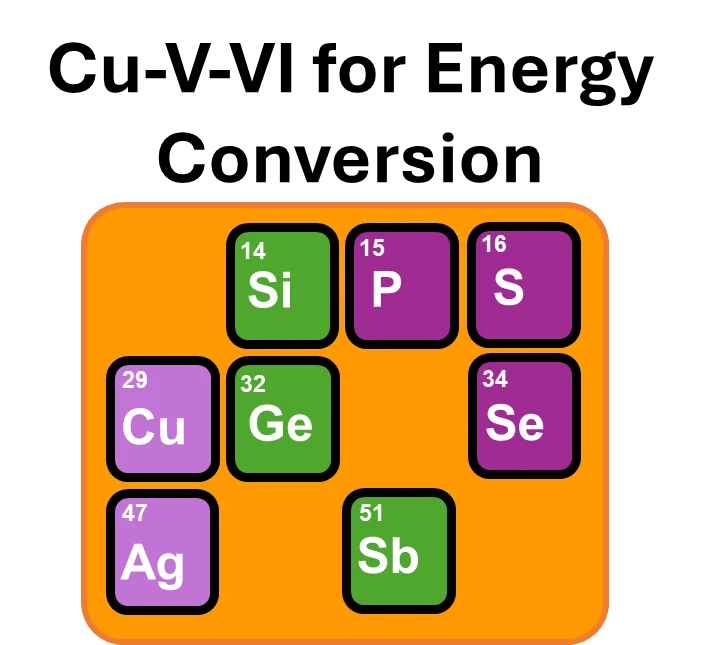
Synthesis and Development of Cu-V-VI Nanoparticles for Energy Conversion
We explore synthetic and mechanistic pathways to develop earth-abundant nanoparticle materials for applications in photovoltaics, thermoelectrics, and battery electrodes.
Synthesis and development of nanoparticle materials for photovoltaics, thermoelectrics, and battery electrodes. Mapping and understanding reaction pathways to access a range of complex binary and ternary phases and morphologies.
We explore synthetic and mechanistic pathways to develop earth-abundant nanoparticle materials for applications in photovoltaics, thermoelectrics, and battery electrodes.
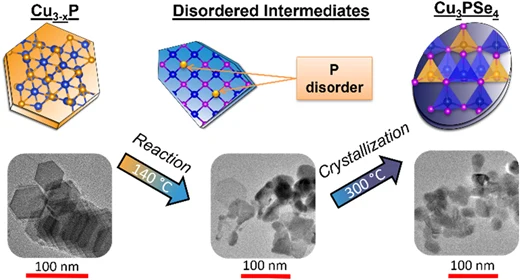
Cu3−xP reacts with a selenium source to give Cu3PSe4. We characterized the intermediate stages of this reaction: X-ray scattering, electron microscopy, and NMR show that the starting particles break apart into disordered, vacancy-rich Cu-Se phases that sequester phosphorus as [PSe4]3− units.
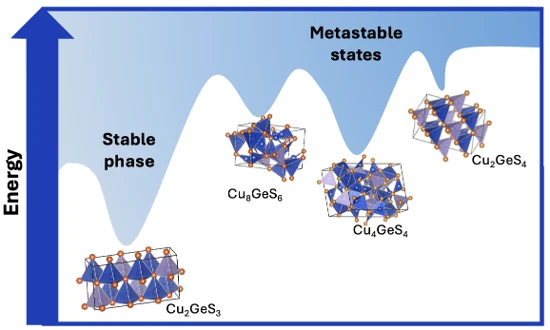
Reaction coordinate diagrams provide a starting point to evaluate reaction landscapes. From this, we can manipulate synthetic parameters that allow us to probe formation pathways of complex ternary nanoparticles.